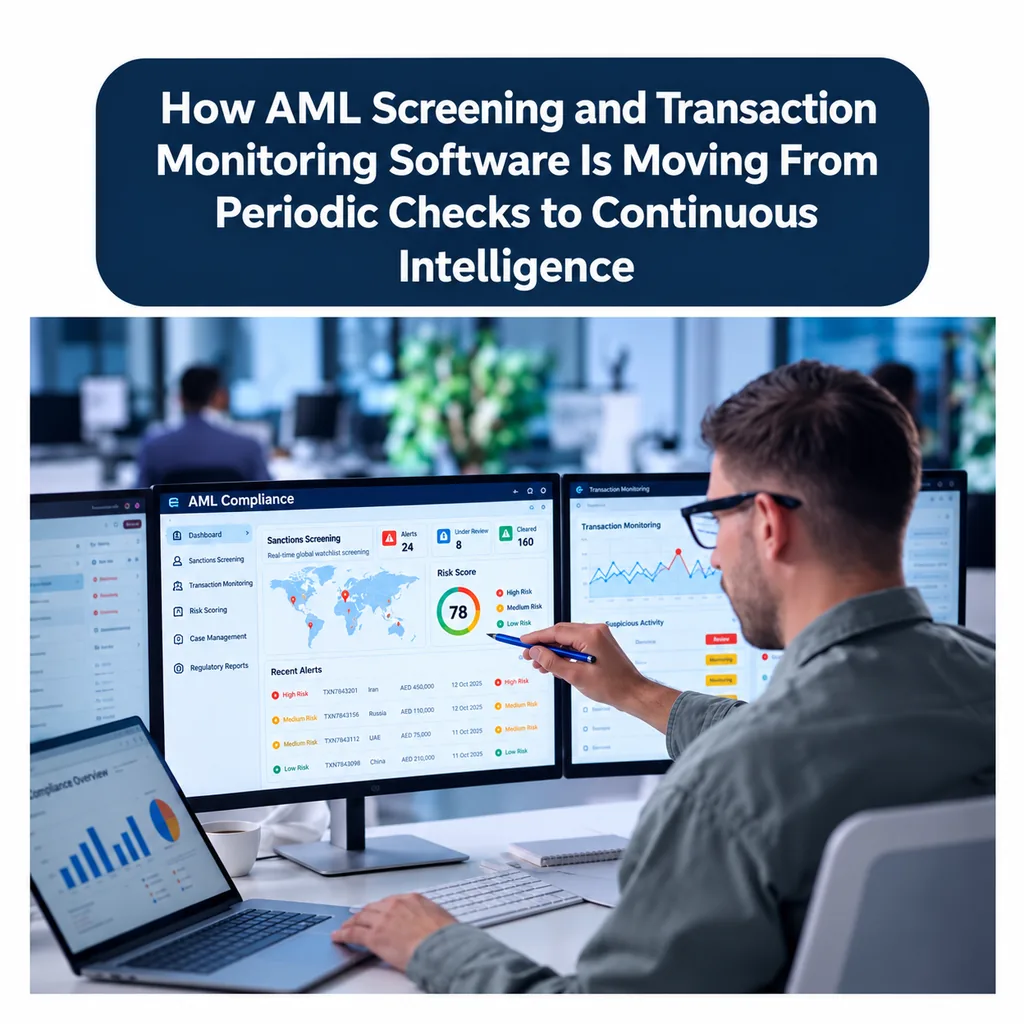
When money moves at remittance speed, compliance can’t lag behind. Exchange houses in the UAE handle cash-heavy customer flows, diverse corridors, and tight settlement windows — which means AML screening must be instant, accurate, and regulator-ready without slowing legitimate transactions.
The goal: keep high-velocity remittances flowing smoothly while intercepting risk with precision.
Here’s a field-tested, UAE-relevant playbook for operations that run hot.
Pattern Flags for Cash-Intensive Corridors
Cash remains convenient for customers — and attractive for bad actors. In the UAE context, several recurring behaviors signal higher risk, especially when paired with high-volume or high-risk corridors:
- Structuring via sub-threshold bursts
Multiple cash deposits just below reporting limits, often across branches or agents, followed by one consolidated payout.
- Ping-pong routing
Rapid in/out transfers between a small cluster of countries with little legitimate economic rationale.
- Beneficiary concentration
Dozens of unrelated senders funding one or a few beneficiaries — a common mule-ring signature.
- Time-of-day anomalies
After-hours or late-evening cash-ins followed by early-morning cash-outs.
- Document recycling
Different names or dates of birth tied to shared addresses, phone numbers, or device IDs.
Modern AML screening systems deployed in the UAE catch these patterns by combining rule-based guardrails with behavior models tuned to corridor seasonality and transaction volatility. The result: fewer blunt-force alerts and more high-fidelity cases investigators can trust.
Sanctions Screening & Travel Rule Discipline for Cross-Border Flows
Sanctions lists shift quickly, and remittance corridors evolve just as fast. Screening needs to happen at every hop — onboarding, beneficiary add, transaction initiation, and payout.
Three focus areas matter most:
- Frequent list updates
UN, OFAC, EU, UK, local UAE lists, PEPs, and adverse media — refreshed multiple times per day.
- Linguistically aware name matching
Arabic/English transliteration, diacritics, multi-part surnames, and regional naming variations. Phonetic and token-aware matching outperforms exact-match engines.
- Travel Rule compliance
Ensure originator and beneficiary information travels with each payment. Validate fields at send; reconcile on receipt. Log exceptions and remediate quickly.
Right-sized AML screening software in UAE deployments relies on real-time APIs — screening inline, not in batch — so compliance stays tight without crushing conversion.
Agent Onboarding, KYC Refresh & Risk Scoring
Agent networks are powerful, but they’re also potential blind spots without structured oversight.
Key practices include:
- KYB and KYC discipline at the edge
Verify agent licensing, ownership, and adverse media. Enforce minimum KYC standards for senders and beneficiaries based on corridor risk.
- Segmented risk scoring
Weigh risk by product (cash vs account), geography, customer profile (occupation, residency), and channel (branch, app, kiosk).
- Periodic refreshes
Time-based (12/24/36 months) plus event-based triggers such as limit-upgrade requests, unusual device fingerprints, or new corridor activity.
- Staff training and attestation
Micro-learning for counter staff and spot checks on SOF/SOW when thresholds or patterns warrant it.
A seasoned anti–money laundering consultant can calibrate these models so genuine walk-ins experience minimal friction, while higher-risk cases receive the necessary scrutiny.
Alert Triage for Lean Compliance Teams
Most exchange houses don’t have large L2/L3 teams, so triage discipline determines both speed and quality.
Smart alert queues prioritize by corridor risk, amount, and entity age. Fresh customers in high-risk corridors rise to the top; long-tenured customers with stable histories go through a lighter-touch review.
Contextual enrichment — KYC data, last transactions, device IDs, shared identifiers, and related-party graphs — should appear automatically in the alert view. Investigators shouldn’t have to check multiple systems to piece together a narrative.
Decision templates help ensure consistent reviews. Simple prompts — purpose of transfer, shared contacts, limit changes, velocity shifts — prevent inconsistencies between investigators.
Feedback loops let compliance teams tag false-positive drivers and feed them back to rules/model owners weekly. Over time, average handling time drops while true-positive rates improve — proof that precision beats volume.
FAQs
- How do we screen beneficiaries without blocking legitimate remittances?
Use layered screening. Start with linguistically sensitive name matching to reduce false hits. Apply risk overlays for corridor sensitivity, receiver velocity, shared identifiers, and device patterns. Then choose allow, soft-hold, or escalate. With the right AML screening software in UAE, this all happens in milliseconds.
- What’s a healthy alert-to-SAR ratio?
There’s no universal benchmark. Strong programs see rising precision: fewer alerts per 1,000 transactions, more true positives, and consistent STR/SAR conversion for genuine risk cases. Track false-positive rate, escalation rate, average handling time, and case-to-STR conversion per corridor.
Get the ComplyFin Playbook
Want a UAE-specific walkthrough for screening, risk scoring, and corridor calibration? Book a consultation and get ComplyFin’s full exchange-house playbook plus tool stack!